Monte Chan talks about “Semantic CF code search with JARVIS (No Arc Reactor Budget required)” in this episode of ColdFusion Alive Podcast with host Michaela Light.
“…With this tool, kind of like an AI bot, if you will, that will give a jump start on the onboarding process… the new employees can just use this bot to get a familiarity with the code base…”
Show notes
- What if you could ask questions about your codebase and get answers instantly?
- Motivated by CodeQL by GitHub (Paid tool)
- “What if a new developer (or a CTO) could just ask the codebase ‘where is the session timeout set?’ and get a real answer instead of grepping for three hours?”
- “You called this a poor man’s J.A.R.V.I.S. Ben Nadel said ‘with great power comes… great self-indulgence.’ Are we about to be very self-indulgent today?
- What is J.A.R.V.I.S.?
- J.A.R.V.I.S. is the fictional artificial intelligence assistant created by Tony Stark in Marvel's Iron Man and Avengers comics and films.
- J.A.R.V.I.S stands for “Just A Rather Very Intelligent System”.
- Codebase ingestion using vector databases
- Walk the repo, split files into chunks (functions, classes, docs), turn each chunk into an embedding (a numeric vector that captures meaning), and store those vectors with metadata (path, line range, language). That index is what makes “where is session timeout set?” searchable by meaning, not just IDE search.
- A vector database is a store optimized for “find the N most similar vectors.” Examples: Pinecone, Qdrant, Milvus, Chroma, LanceDB, plus CF’s built-in / in-memory store for demos. Code search is usually hybrid: vectors for meaning + keyword/BM25 for exact symbols.
- How you chunk CFM/CFC/JS/SQL differently
- Why you store a summary + metadata and embed that
- The current gap: CF’s built-in document ingestion doesn’t yet understand CFC/CFML structure, so custom scripts are required
- PDFs can be ingessed directly
- Updating the vector store when your codebase changes
- Prompt-driven code exploration
- Prompt-driven code exploration: You ask in English. The system retrieves the relevant chunks, stuffs them into the prompt, and the model answers from that context. That pattern is RAG (retrieval-augmented generation): retrieve first, then generate, so the model is grounded in your code instead of guessing
What you need” slide with practical commentary:
| Piece | Why it matters | CIO translation |
| CF 2025 Update 8 | Native AI, vector stores, agents, MCP | No new language or Python sidecar tax |
| Vector store (Qdrant / Milvus / Pinecone / Chroma) | In-memory is too small for real apps | Persistent, scalable “memory” for the AI |
| LLM (Anthropic, OpenAI, or Ollama local) | The brain | Cloud vs on-prem / air-gapped choice |
| Ingestion script | CF can ingest docs today; CFC/CFML still need custom work | One-time + ongoing cost of keeping the index fresh |
| MCP (optional but powerful) | File-system or other tools the agent can call | Controlled agency—AI can look without unrestricted access |
Key terms
- Vector store / embeddings – numbers that capture the meaning of code so similarity search works
- Chunking by logical entity (whole function, not random 500-token slices) – this is the quality differentiator
- Summary-first embeddings – embed a rich description (purpose, path, callers, callees) rather than raw code only
- MCP (Model Context Protocol) – open standard so the agent can safely call tools (filesystem, DB, etc.)
- Ongoing ingestion – full re-index vs git-diff / pipeline-after-merge
- Adobe folded LLM, embedding, vector-store, RAG, agent, and MCP APIs into the CF engine (commonly described as CF 2025 Update 8 / the “CF 2026” AI wave). You call models from CFML (ChatModel(), agent(), simpleRAG(), VectorStore(), etc.) instead of wiring every provider by hand.
- MCP (Model Context Protocol)
- An open standard so tools/resources are exposed the same way to Claude, Cursor, VS Code, ChatGPT, etc. CF can host MCP servers or call MCP tools. Community projects like MCPCFC wrap existing CF functions as MCP tools.
- Similar commercial tools
- Sourcegraph Cody, Continue.dev, custom LanceDB/Qdrant indexers
- A fascinating look at how AI can help developers understand and navigate complex applications.
CIO / risk / value questions
- Time-to-answer for audits, compliance questions, or new-hire onboarding
- Reducing “bus factor” / key-person risk
- Security posture:
- Local Ollama option (data never leaves the building)
- Guardrails and “excessive agency” concerns (echo Pete Freitag’s CF Summit security talk)
- Prompt injection surface when the AI can call tools
- Cost model: vector DB + LLM tokens + ongoing ingestion vs. developer hours spent hunting code
- Build vs buy: this is a capability you can own inside the CF platform rather than another SaaS
Practical next steps & gotchas (5- 6 min)
- Minimum viable version a team could stand up in a sprint
- Biggest surprise or pain point he hit while building it
- What CF 2026 still needs (better CFC/CFML-aware ingestion is the obvious one)
- Where the slides and sample code live: github.com/knittingguy (JARVIS repo + the earlier mongoDB-langchain / aiagent_cf work)
Close & resources
- One sentence each for the CF developer and the CIO listening
- Ben Nadel quote callback
- Point people to the GitHub, MCP servers list (mcpservers.org), and Monte’s Facebook/Geek Talk channel
- Invite questions from the live or later audience
- Why are you proud to use CF?
- WWIT to make CF more alive this year?
- What are you looking forward to at the Adobe CF Summit East?
Mentioned in this episode
- 133 GitHub Copilot & AI-Assisted Coding (Unlocking ColdFusion’s AI Potential) with Monte Chan
- Qdrant vector database
- CF 2026 features (TT blog)
- MCP servers
- CF Summit East
- Monte's GitHub
Listen to the Audio
Podcast: Play in new window | Download | Embed
Subscribe: RSS
Bio
Monte Chan
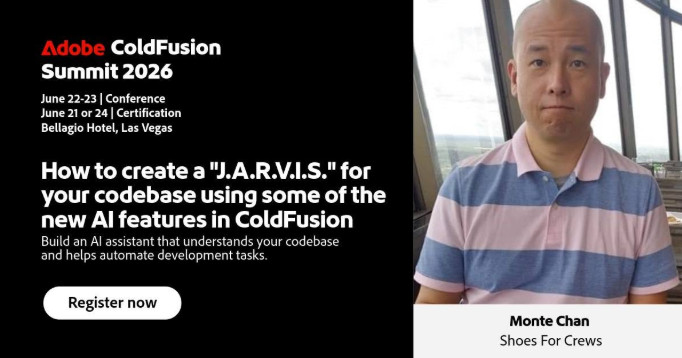
Monte Chan is currently a Senior Web Programmer at Shoes For Crews. He has been programming in ColdFusion since version 4.5 back in 1999. He was a co-manager of the Alamo Area ColdFusion User Group from 2008 to 2010. In his free time, he enjoys learning any web development related technologies or just programming languages he can put his hands on. He also enjoys running marathons; he does not run fast; he just runs🙂. He currently resides in San Antonio, TX with his beautiful wife and three rescue dogs (two chiweenies and one pure-bred chihuahua).
Links
- You can email me at monte (at) monteandjanicechan.com but you may get a quicker response if you send me a message in Facebook Messenger.
- YouTube channel, Geek Talk.
- GitHub
Interview transcript
Michaela Light
So welcome back to the show. I'm here with Monte Chan and we're going to be talking about semantic ColdFusion code search with Jarvis. And you don't need an Arc Reactor budget to do this because it's all written in ColdFusion. So welcome, Monte.
Monte Chan
Oh, thank you.
Michaela Light
And it's been a few years since you've been on the show when you were talking about your AI coding experience. And I'll put that episode in the show notes at TeraTech.com. But let me introduce you to folks who haven't met you before. You're currently a senior web programmer at Shoes for Crews, and you've been programming ColdFusion since version 4.5 back in the late '90s. You used to be the co-manager of the Alamo Area ColdFusion User Group.
And in your free time, I don't know how you have free time because I've seen you presenting at CF Summit and I know you work hard. You enjoy learning any web development-related technologies or just programming languages that you can get your hands on. And also, you enjoy running marathons, though you don't have any world-record times there. You just enjoy it, do it for fun.
Currently, you're in San Antonio, Texas, and you have a beautiful wife and three rescue dogs. Two chiweenies and one purebred Chihuahua. What is a chiweenie? I've never heard of that. Chihuahua is the little dog, right?
Read more

Michaela Light is the host of the CF Alive Podcast and has interviewed more than 100 ColdFusion experts. In each interview, she asks "What Would It Take to make CF more alive this year?" The answers still inspire her to continue to write and interview new speakers.
Michaela has been programming in ColdFusion for more than 20 years. She founded TeraTech in 1989. The company specializes in ColdFusion application development, security and optimization. She has also founded the CFUnited Conference and runs the annual State of the CF Union Survey.
Join the CF Alive revolution
Discover how we can all make CF more alive, modern and secure this year. Join other ColdFusion developers and managers in the CF Alive Inner Circle today.- Get early access to the CF Alive book and videos
- Be part of a new movement for improving CF's perception in the world.
- Contribute to the CF Alive revolution
- Connect with other CF developers and managers
- There is no cost to membership.