If you’re a CEO, the hidden cost of legacy ColdFusion can torpedo your company’s M&A valuation. And the only person looking like a hapless Hobbit will be you.
Most boards dance around the subject of ColdFusion maintenance. First, it’s boring. Secondly, it’s abstract. Plus, it shouldn’t be an issue. Instead, they ask about stability, security posture, and technical debt. The sort of orcs that aren’t an issue if you’ve got a consistent ColdFusion maintenance set-up.
The real cost of a legacy ColdFusion app accumulates quietly across four categories. Think “one ring, four problems,” except the goal here involves fewer surprises and fewer late-night quests.
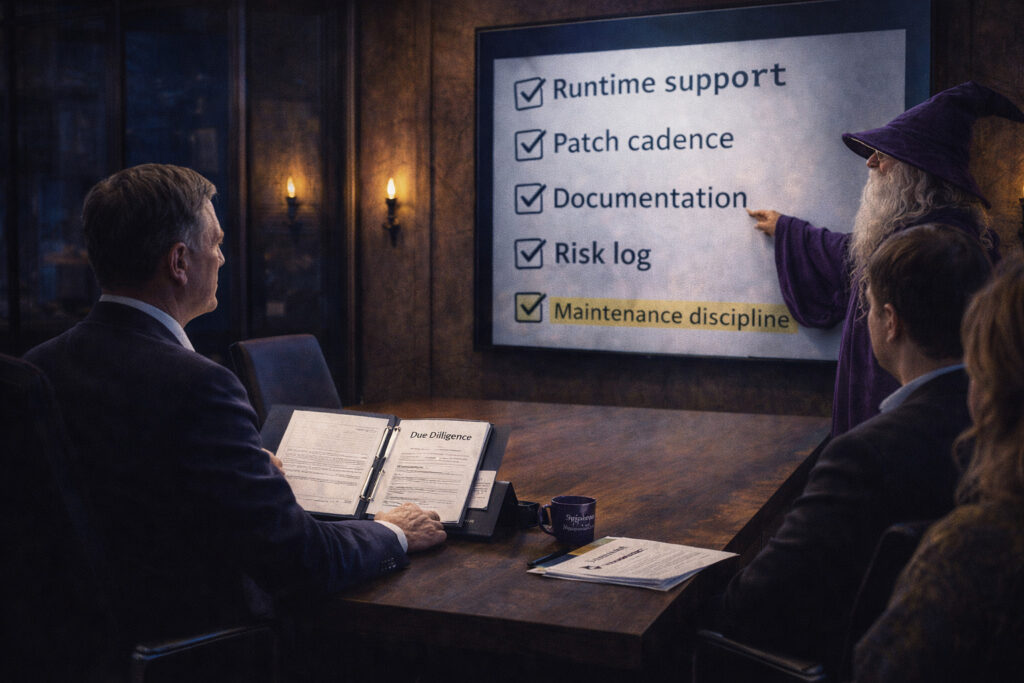
Keeping your cf maintenance in ship shape keeps the m&a balrogs away.
1) Opportunity cost
A CF team that spends 20 to 30 percent of its time on reactive maintenance spends less time building features that move the business forward. They’re busy battling orcs instead of trying to destroy the ring. Structured maintenance reverses that ratio through predictable patch cadence, performance hygiene, and clear ownership.
2) Talent cost
Treat good CF developers like the Fellowship: hard to assemble, and even harder to replace. Experienced developers avoid environments where legacy ColdFusion is not given consistent care. They also try to avoid legacy CF in general, if they can. It’s the CF equivalent of working in Mordor. Strong contributors and experienced talent often leave because the codebase drains morale. Valuable institutional knowledge walks out the door with them, while hiring and staffing costs rise. That knowledge rarely comes back. At best, it takes a lot of time and money to recoup.
3) Incident cost
Older ColdFusion servers (some even predate the Lord of the Rings movie trilogy) build up unpatched vulnerabilities and configuration drift. When an incident hits, the fully loaded cost includes overtime for CF developers and breach notification obligations. Damage to customer trust never shows up on a spreadsheet. You don’t get to pick your battles, either. Incidents also tend to arrive with Nazgûl-like timing, which means “never convenient.”
4) Transaction cost
M&A triggers technical diligence that’s more than just a quick scan and thumbs-up emoji. It’s more like the persistence of a certain all-seeing eye. Buyers review CF runtime support status, patch currency, and documentation that proves ongoing maintenance discipline. Weak answers shift leverage and reduce valuation.
The Takeaway
A structured ColdFusion maintenance program addresses all four cost categories. It functions as a risk reduction investment with a measurable return.
About the author:




